Written By

Sonju Ghosh
Growth Lead
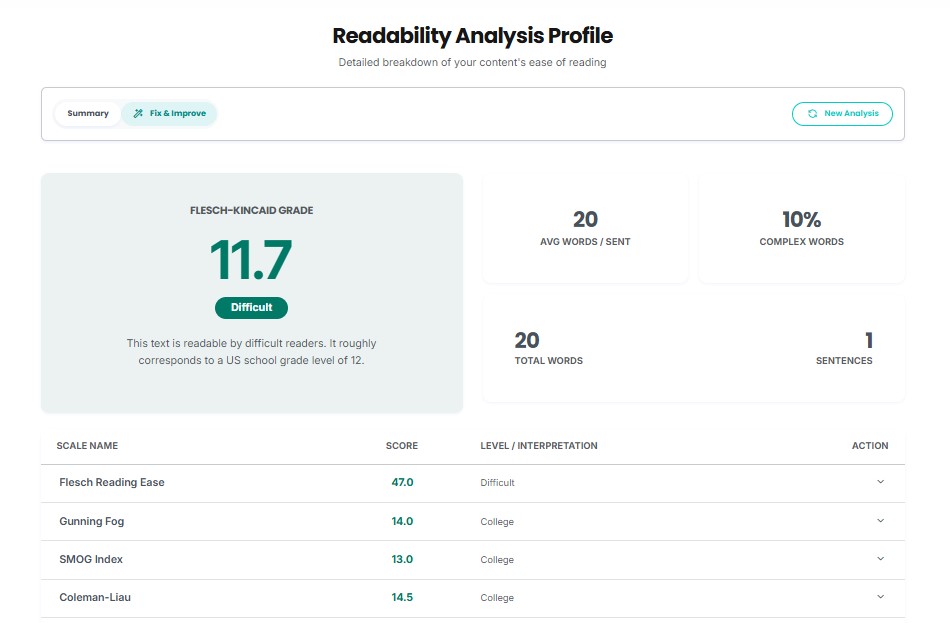
Modern SEO is no longer just about keywords and backlinks. It focuses heavily on user experience (UX), and one of the most underrated yet powerful elements of UX is readability.
In fact, Google�s algorithms are increasingly designed to prioritize content that humans find easy to consume. But how exactly does readability affect SEO? And how can you optimize your content to boost both your rankings and engagement?
The Dofollo team has curated this comprehensive guide to help you understand why readability matters and how to implement it effectively.
💡Is link equity leaking from your best pages? Dofollo finds it free — no credit card, no setup time.
Start Free AuditWhat is Readability?
Readability is a measure of how easy it is for a reader to understand a written text. It�s determined by several factors, including:
- Sentence Complexity: Are the sentences short and punchy or long and convoluted?
- Vocabulary Choice: Are you using simple, common words or jargon and industry-speak?
- Formatting: Is the text broken up with headings, lists, and images, or is it a �wall of text�?
- Visual Elements: Are you using fonts, line spacing, and contrasting colors that make reading painless?
How Readability Affects SEO: The Indirect Impact
While readability isn�t a direct ranking factor (like page speed or mobile-friendliness), it significantly impacts the metrics that Google does use to judge content quality.
1. Bounce Rate and Dwell Time
If a visitor lands on your page and is hit with a giant block of difficult text, they�re likely to �bounce� back to the search results. Google notices this. A high bounce rate combined with low dwell time (the time spent on a page) signals to Google that your content didn�t satisfy the user�s intent, which can lead to lower rankings.
2. Improved Indexing and Crawling
Clear, easy-to-read content often follows a logical structure with proper header tags (H1, H2, H3). This structure helps search engine spiders crawl and understand your content more efficiently, making it easier for Google to rank you for the right keywords.
3. Voice Search Optimization
As voice search becomes more prevalent, readability is more important than ever. Voice search queries are typically conversational. Content that flows naturally and is easy to read aloud is much more likely to be featured in voice search results.
4. Increased Backlinks and Social Shares
People share content they understand and find valuable. If your guide or article is easy to digest, other sites are more likely to link to it as a resource, and your audience is more likely to share it on social media. This builds the authority (E-E-A-T) that Google loves.
Document
Manage Your Internal Links
with
AI for Better SEO Rankings Check Your Internal Links
No Technical Knowledge Required
Get Notified for Your Backlinks
Removals
Top Readability Best Practices
Now that we know why it matters, let�s look at how to optimize your content for readability. Follow these best practices to ensure your content is as accessible as possible.
1. Use Short Sentences and Paragraphs
Long sentences are hard to follow. Aim for an average of 15 to 20 words per sentence. Similarly, keep your paragraphs short. Each paragraph should focus on a single idea and shouldn�t exceed 3 or 4 sentences. White space is your friend!
2. Write for an 8th-Grade Level
Even if your audience is highly academic, they will still appreciate simple, clear writing. Tools like the Flesch-Kincaid Readability Score can help you measure this. Writing at an 8th-grade level makes your content accessible to the widest possible audience without sacrificing quality.
3. Break it Up with Headings and Subheadings
Headings acts as a roadmap for your readers. Use H1 for your title, H2 for main sections, and H3 for subsections. This allows readers to scan your content and find exactly what they�re looking for.
4. Use Bullet Points and Numbered Lists
Lists are incredibly easy to scan. Whenever you have a series of items, steps, or features, use a list instead of a comma-heavy sentence. This makes the information pop and is much easier to digest.
5. Use High-Contrast Colors and Large Fonts
Readability isn�t just about the words; it�s about the visual experience. Use dark text on a light background (or vice versa) and ensure your font size is large enough to read comfortably on mobile devices (at least 16px).
6. Add Relevant Images and Media
Images, infographics, and videos act as visual breaks in your text. They not only make the content more engaging but also help illustrate complex points in a simpler way.
Don�t Forget Internal Linking!
A well-structured internal linking strategy further enhances readability by providing a clear path for users to discover more related content. If a user finds a term they don�t understand, or wants to dive deeper into a specific subtopic, an internal link is the perfect guide.
Using a tool like Dofollo makes this part easy. It audits your internal links and finds new opportunities to connect your content semantically, ensuring that your readers (and search engines) can easily navigate your entire site.
Conclusion
Readability is no longer optional in modern SEO. By making your content easy to consume, you improve user engagement, decrease bounce rates, and signal to Google that your content is high-quality. Start implementing these readability best practices today, and watch your SEO performance soar.
Ready to automate your internal linking strategy? Try Dofollo free today!
About The Author